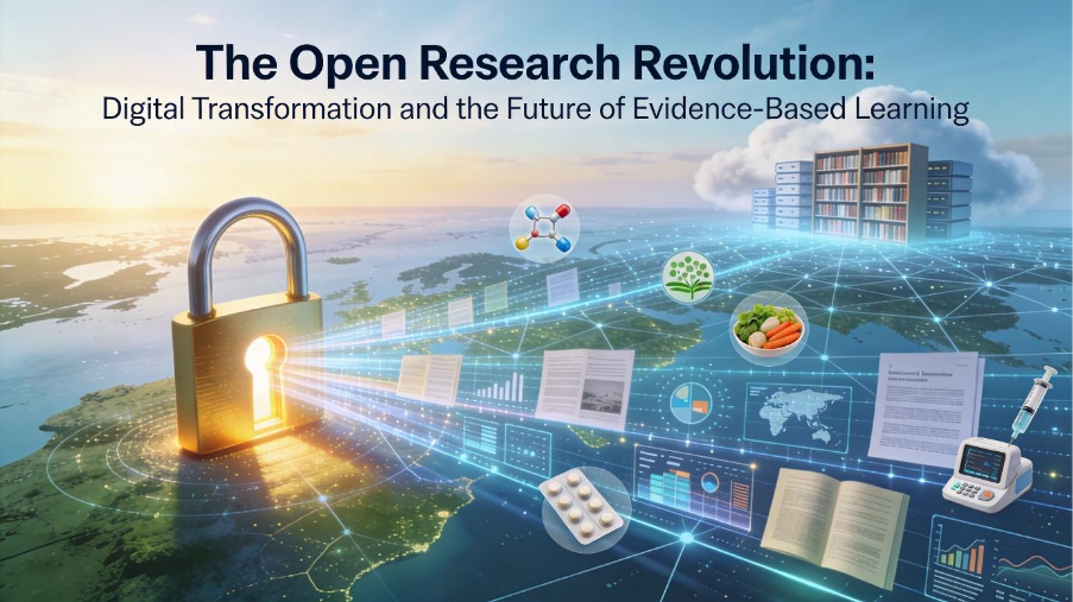
The Open Research Revolution: Digital Transformation and the Future of Evidence-Based Learning
Author: Colm O’Connor, College Librarian & Research Specialist, Innopharma Education
In today’s rapidly evolving academic landscape, the way we access information is undergoing a fundamental shift. For students at Innopharma Education—many of whom are busy professionals leading careers in highly regulated industries—accessing the right information is the cornerstone of academic and professional excellence. Driven by digital transformation, utilising high-quality peer-reviewed research data is a critical skill for both success in assignments and making evidence-based decisions in the workplace.
One of the most significant trends over the past five years has been the dramatic rise of Open Access (OA) research and the broader digital transformation of academic libraries. Open access material includes a wide range of resources, such as journal articles, scholarly and scientific monographs, educational materials, digitised content, and research data. Unlike traditional academic publishing, which often sits behind expensive paywalls, Open Access resources are digital, online, and free of charge. This movement has democratised information, ensuring that the latest scientific breakthroughs are available to everyone.

The Shift Toward Open Access Across Our Core Subjects
The landscape of scholarly communication has changed significantly. While the global average for scholarly articles available via Open Access is now approximately 50% (STM, 2024), certain high-tech and medical fields have seen even more rapid adoption, especially in the United States and Europe where open science initiatives are most prevalent.
- Pharmaceutical Science: The “Open Pharma” movement has fundamentally reshaped how the pharmaceutical industry communicates its findings, moving away from a tradition of proprietary information hoarding toward a model of transparency. Recent data underscores this trend revealing that approximately 77% of pharmaceutical company research publications are now published as Open Access (Nobes, 2024).This high rate of adoption is largely driven by a strategic shift in corporate communication and research dissemination, as companies recognise that freely accessible data increases the citation impact and clinical reach of drug discovery and safety studies. This supports Open Access research for professionals, enabling faster knowledge transfer and strengthening evidence-based decision making in the industry. By ensuring that nearly four-fifths of their output is available without a paywall, pharma companies are not only complying with strict funder mandates but also building public trust and accelerating the pace of therapeutic innovation through real-time, global data-sharing.
- Food Science: The landscape of academic publishing in food science is undergoing a significant transformation, with Open Access (OA) availability now reaching approximately 50% of all research. This accelerated shift reflects a broader commitment to transparent data-sharing and collaborative action, particularly in critical areas like food safety and sustainable food systems. Major developments, such as the International Journal of Food Science & Technology becoming fully Open Access in January 2025 (IJFT, 2025), have played a pivotal role in democratizing access to decades of research. As a result, researchers, policymakers, and the public can now freely access a substantial portion of new findings, fostering innovation and quicker responses to global challenges.
- Digital Transformation: No specific sources pinpoint exact Open Access (OA) rates for digital transformation research, a domain intersecting business, IT, and process innovation. However, mirroring trends in adjacent high-tech domains like pharmaceutical science (77% OA) and broader scholarly publishing averages (~50%), adoption likely falls in the 40-50% range. This estimate aligns with accelerating OA growth in Europe and the US, where mandates and digital sharing demands propel fields reliant on rapid dissemination and high citation rates. The momentum supports collaborative innovation in digital tools and strategies, enhancing real-world applications without paywalls.
- Medical Technology (MedTech): Open access (OA) adoption in medical device publishing remains limited compared to biomedicine or pharma research, with no comprehensive recent data pinpointing exact rates but evidence suggesting overall shares below 50%—often under 20% in engineering-adjacent fields like biomedical engineering. Dedicated OA journals are scarce, Medical Devices: Evidence and Research being one of the few actively publishing new articles. However, as open science initiatives gain momentum worldwide, MedTech is poised for accelerated OA growth, promising broader innovation and accessibility for life-changing medical advancements.
Digital Transformation: A Library Built for Professionals
At Innopharma Education, we have embraced this digital transformation by building a digital academic library that is available 24/7. This “digital-first” approach ensures that whether you are on a break at work or studying late at night, you have immediate access to:
- Verified Accuracy: Access to the very latest findings in sectors like Pharmaceutical science ensures your work is grounded in current reality.
- Diversity of Perspective: A broader range of global academic resources that provides a more holistic view of industry trends than traditional commercial databases alone.
- Flexibility: Seamless off-site access – no need to come to a physical library, access the latest research while watching Netflix on the couch!

Ensuring Excellence: Our Curated Lists
The challenge for modern researchers is no longer finding information—it’s filtering out the noise to find reliable information. The Innopharma Education Library team serves as your academic partner in this process. We don’t just provide a search bar; we curate lists of high-quality resources specifically relevant to your core disciplines. These databases support academic research for working professionals, ensuring reliable access to current evidence.
Our curated lists include:
Key Open Access Databases
We provide direct access to world-leading databases that ensure our learners have the latest research at their fingertips:
- CORE: The world’s largest aggregator of open access research papers.
- Open Alex: A fully open index of the global research system.
- OA.MG: A powerful search engine for open access scholarly papers.
- Lenus: The Irish Health Repository, which is vital for those in clinical and pharmaceutical studies.
- Refseek: A search engine for academic sources with an index of over one billion documents.
Journals and Books
- Journals: Direct links to major collections like the Directory of Open Access Journals (DOAJ), MDPI and Frontiers.
- Books: Curated titles from the Directory of Open Access Books (DOAB) and the Open Textbook Library.
- Institutional Output: Innopharma Education’s own Institutional Repository (DSpace) hosts research from our own scholars and graduates, including hundreds of full-text dissertations, contributing our community’s expertise back to the global pool of knowledge.
Staying Ahead of the Curve
The world of digital research is dynamic, and our library team continually reviews these resources to ensure our learners have the most current data to support their studies. By mastering these digital tools and using the right information, students build the high-level research skills required to be a leader in the MedTech, Pharma, and Food Science industries.
References
IJFT (2025) The International Journal of Food Science & Technology is now fully open access | International Journal of Food Science and Technology | Oxford Academic. Available at: https://academic.oup.com/ijfst/pages/move-to-open-access (Accessed: February 6, 2026).
Nobes, S. (2024) “Benchmarking open access publication rates,” Open Pharma – Innovations in medical publishing, 22 October. Available at: https://www.openpharma.blog/blog/news/benchmarking-open-access-publication-rates/ (Accessed: February 6, 2026).
STM (2024) “Uptake of Open Access,” STM Association. Available at: https://stm-assoc.org/oa-dashboard/oa-dashboard-2/uptake-of-open-access/ (Accessed: February 6, 2026).